I'm currently working on the backscene for Polbrook Gurney Colliery (see link to right) which will be light, misty and distant. The original is 7 x 2ft and will feature wrap around the ends thus avoiding sharp corners in the sky. It has been created photographically as per my recent feature in Model Rail magazine.
2ft is quite high, to me this is important which means that photography, even when looking up at the colliery buildings you'll still see the backscene behind the layout rather than room the layout is in.
This combined with bright even neutral illumination (yet to be decided, but it won't be spots which are dreadful!! LED might be an option btw.) should give a good airy spacious feel which hopefully will disguise the 4 x 2ft footprint and fool people into thinking the layout is much bigger.
Deadline, end of May at Railex!
Polbrook Gurney Colliery will shortly be featured in far greater detail in Model Rail magazine.

About Me
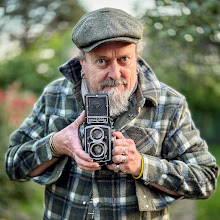
- Chris Nevard Model Railways & Photography
- Professional Photographer, Model Maker, Writer & Pretend Musician
28 February 2013

16 February 2013
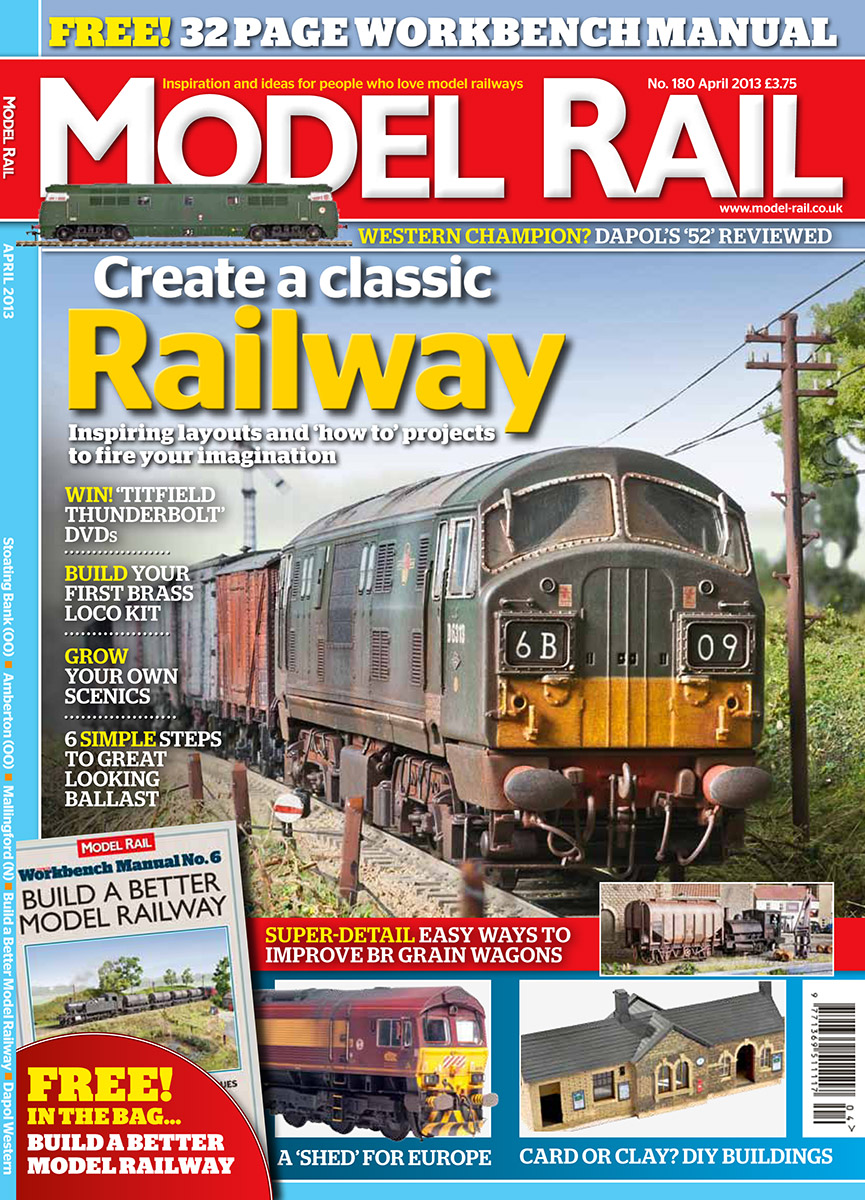
One Hundred & Eighty!
Reviews:
Dapol 'OO' Western class diesel-hydraulic
Metcalfe 'OO' stone station building
Layouts:
Mallingford 'N'
Stoating Bank 'OO'
Amberton 'OO'
Features:
Annual wish list
Network Rail stoneblower
Gilbert Barnatt on operation
Inside the World's largest model railway
Workbench:
How to ballast track (GD)
Create a Euro Class 66 (GD)
Cast stone low relief shops/LNER hopper wagon kit (George Dent)
Grow your own sea foam (Peter Singer)
Build a simple etched loco kit (GD)
Station buildings in card and in DAS clay (CJL) -Bishopstone/Oakworth
Improve a grain wagon (Chris Nevard)
...plus the regulars including Q&A, George's Diary, Exhibition Diary, Backscene.
Click on the photos below to enlarge,
Amberton 'OO'
 |
| Photo © Chris Nevard/Model Rail |
 |
| Photo © Chris Nevard/Model Rail |
 |
| Photo © Chris Nevard/Model Rail |
12 February 2013
Track Down
Polbrook Gurney Colliery update...
All the track is now down and copper clad sleepers gapped. Temporary wiring confirms it all works. Next stage will be cosmetic chairs on the point in the foreground, cosmetic fishplates, painting and weathering.
The sidings are code 55 flatbottomed rail and the track there will be ballasted to represent fine clinker. The 1 in 20 grade into the colliery is shown off well from this angle.
The wall the colliery pithead building stands on will be clad in stone to match what's there and will be coloured accordingly to blend in. A still to be built loading screen will extend out over where the wagons are and will be based on what used to be at Writhlington Pit.
Just 3.5 months to go before the first show - RAILEX in Aylesbury.

All the track is now down and copper clad sleepers gapped. Temporary wiring confirms it all works. Next stage will be cosmetic chairs on the point in the foreground, cosmetic fishplates, painting and weathering.
The sidings are code 55 flatbottomed rail and the track there will be ballasted to represent fine clinker. The 1 in 20 grade into the colliery is shown off well from this angle.
The wall the colliery pithead building stands on will be clad in stone to match what's there and will be coloured accordingly to blend in. A still to be built loading screen will extend out over where the wagons are and will be based on what used to be at Writhlington Pit.
Just 3.5 months to go before the first show - RAILEX in Aylesbury.
10 February 2013
Backscenes
 |
| A bit bigger than a 7x5! |
In the forthcoming Railway Modeller article, Paul will illustrate a neat way to put a photo backscene into use which will put an end to tatty joins, air bubbles and how to keep it pristine when not in use.
http://albionyard.wordpress.com/2013/02/09/the-backscene-railway-modeller-march-2013/
The excellent Albion Yard will be appearing in Model Rail in 2013 - it will definitely be worth keeping an eye out for with some seriously eye-catching photography (I had to say that because they're my photos).
- Model Rail back issues obtained for a few sovs by calling one of these numbers Missed it? 0844 848 8872 Overseas +44 (0) 1858 438 828
01 February 2013
Tracklaying
Here's a proper shot taken of today's track laying which has finally commenced. It's code 55 flatbottomed on the colliery lines for that industrial feel. You can see how Polbrock fits into the scene over there on the left.
Up near the distant loco in the middle, the switch rails and frog still need to be fabricated. The crossing in the foreground may be lifted or simply turned into a non-road access. Note the 1 in 20 gradient going up into the colliery, not an uncommon thing with the real thing which could often be very steep and frequently steeper than this. Only a few wagons at a time will go up here so not an issue.

Up near the distant loco in the middle, the switch rails and frog still need to be fabricated. The crossing in the foreground may be lifted or simply turned into a non-road access. Note the 1 in 20 gradient going up into the colliery, not an uncommon thing with the real thing which could often be very steep and frequently steeper than this. Only a few wagons at a time will go up here so not an issue.
24 January 2013
Polbrook Gurney Colliery - 16 weeks to go!


The backscene will be a gnats under 2 ft high (mostly a clouds on a 21 x 90 inch print wrapped around back and the ends). I was going to have pale blue as with Polbrock but quite like the summery clouds as here.
Behind the pub (Pedant & Armchair) and to the right of the track will possibly be a drainage pond, a stinking polluted place with orange mud.
The colliery buildings, since these two photos are now around an inch higher than here, the only structure still needed will be a small Writhlington-esque screen. That will be an afternoon job with a bit of corrugated sheeting.
- Polbrook Gurney Colliery as with Polbrock and Brewhouse Quay and will form part of a forthcoming serial in Model Rail, in there I'll go into far more detail than here.
21 January 2013
Polbrook Gurney Colliery Halt
Polbrook Gurney Colliery Halt is Polbrock as serialised in Model Rail last year, but now in the process of being extended width and lengthwise to incorporate a Bristol coalfield inspired colliery from my moribund Mendip Colliery project.
The layout here looks more complete than it really is, the photo here being the result of carefully lining up colliery buildings behind Polbrock, which earlier today was extracted from its diorama case.
The sky I admit has been Photoshopped in, but is very similar to what I have planned to go behind this somewhat bigger metamorphosis of Polbrock. The new backscene will be around 18 inches high to allow photos like this without having to resort to filling in the sky to cover up the ceiling or exhibition hall with a photo-editing programme.
Anyway, enough rambling, I need to pull my thumb out to get it finished in time - First outing is RAILEX end of May!

The layout here looks more complete than it really is, the photo here being the result of carefully lining up colliery buildings behind Polbrock, which earlier today was extracted from its diorama case.
The sky I admit has been Photoshopped in, but is very similar to what I have planned to go behind this somewhat bigger metamorphosis of Polbrock. The new backscene will be around 18 inches high to allow photos like this without having to resort to filling in the sky to cover up the ceiling or exhibition hall with a photo-editing programme.
Anyway, enough rambling, I need to pull my thumb out to get it finished in time - First outing is RAILEX end of May!
13 January 2013
A most unusual GWR branch line terminus!
 |
| Click to enlarge |
This show, out of the many I have visited over the years appeared to embrace a broader spectrum of layouts than many others I've been to, with everything from 2mm finescale (2FS), 3mm to the foot, depicting Brunel's 7 foot(!), P4, S Scale, OO, N, 0 gauge and so on, with a little HO thrown in for good measure. As I write this, I don't think I've ever been to a show with so much variety on the scale/gauge front ever - apart from maybe The Warley Show at the NEC.
 |
| Click to enlarge |
Earl's Court, illustrated here is just one of those layouts, it depicting a 'could have been' LMS/GWR joint 'overground' terminus in West London during its final years - a most unusual GWR branch line terminus! Having lived in the capital for many years, it has all those key features that shout 'West London'; the rundown cramped location, much of it still showing signs of wartime damage from 20 years prior with the yet (and never) to be replaced canopy, a mix of Western Region diesel multiple units, a little mixed WR/MR steam and some 4 rail activity, milk tanks, parcels stock and so on. Despite run down location there are is a hint of modernisation, with new fluorescent platform lamps contrasting with much wrought iron from the turn of the century, the old century that is.
With a model as well observed as this, the gauge, scale, flange width or the code of rail is totally unimportant. Don't worry I'm not anti the 'correct gauge' thing, but I do think that maybe all those other less obvious things that make a layout 'real' should also be looked and maybe greater emphasis on design, composition and colour should not be forgotten. The key to that, is looking at the real world, whether it be first hand, photos in books, or the internet, then throw away the calipers and absorb the atmosphere. For me, all that was missing was the smell of disinfectant, the pong of a bad sewerage system and maybe the smell of that new Chinese restaurant that's just opened next to the coffee bar with Radio Caroline playing on that new new fangled battery powered transistor radio.
Visit Earl's Court's (the model) website here http://ecmr.webs.com/
09 January 2013
Wednesday's Load of Old Rubbish

The joy of toy trains is that one can create and write all sorts of rubbish to support rose tinted excuses to run what ever one wants to run. The above being my excuse for a loco well and truly away from its beaten track which would have been from the other side of the country. Mix a bit of real history in and it's a little more believable and is probably good enough for most, apart from those that don't really enjoy the hobby and the fun escapism it brings to most of us.
Click on the photo to enlarge by the way...
08 January 2013
Tuesday Photo
For a short wihile in 1962 Stanier 4MT tanks were tried out on the former SDJR system. Captured through the photographer's new 200mm lens, the dark sky in the distance would suggest a thunderstorm over the Bristol Channel.
Anyone with a litle knowledge of this now gone but much loved route will know that te above is a load of old balony. However various engine types were tried out over the former Somerset & Dorset Joint Railway network, with some quite oversized engines appearing during the line's final few years. In the autumn of '63 BR Standard Class 9 locos with their large (by British standards) 2-10-0 wheel configeration returned, not to haul summer Saturday expresses but the Bath to Bournemouth 3 coach stopping service. Later BR Std Class 4 tanks appeared to on the 'mainline' too as dieselisation cascaded engines to 'lesser routes'.
Much of the 'Branch' (Evercreech to Highbridge and Burnham on Sea) went across the Somerset Levels following the route of the old Glastonbury Canal, and I believe much of it floated over the extensive peat bog probably using branches from the locally willow tree as a base. For this reason light weight engines were usually the norm. A railtour in the early 1960's did however bring a couple of SDJR 7f goods locos down the line and I imagine Highbridge Loco before 1930 bought severaly bigger types through too.
However despute the above, I do think the above large Stanier Class 4 tanks fit in quite well, so in that parallel universe of 'it's my trainset' who knows!

Anyone with a litle knowledge of this now gone but much loved route will know that te above is a load of old balony. However various engine types were tried out over the former Somerset & Dorset Joint Railway network, with some quite oversized engines appearing during the line's final few years. In the autumn of '63 BR Standard Class 9 locos with their large (by British standards) 2-10-0 wheel configeration returned, not to haul summer Saturday expresses but the Bath to Bournemouth 3 coach stopping service. Later BR Std Class 4 tanks appeared to on the 'mainline' too as dieselisation cascaded engines to 'lesser routes'.
Much of the 'Branch' (Evercreech to Highbridge and Burnham on Sea) went across the Somerset Levels following the route of the old Glastonbury Canal, and I believe much of it floated over the extensive peat bog probably using branches from the locally willow tree as a base. For this reason light weight engines were usually the norm. A railtour in the early 1960's did however bring a couple of SDJR 7f goods locos down the line and I imagine Highbridge Loco before 1930 bought severaly bigger types through too.
However despute the above, I do think the above large Stanier Class 4 tanks fit in quite well, so in that parallel universe of 'it's my trainset' who knows!
31 December 2012
Happy New Year
Above is an old Agfa CT18 slide of dropping off water churns at Catcott Crossing taken around 1962. It's going to be quite a job to restore this one to clear away the mould and scratches. The lens on the original camera was not that great either, with quite a bit of astigmatism at the edges of the field. Luckily though the photographer had his twin lens Rollei and grabbed a decent B&W shot here.
Well that was 2012, and quite a busy year it's been with another layout making its debut in the form of Polbrock, and then there's been all the magazine photography which has taken me up, down and across the country to play with and photograph other people's cracking and lovely layouts for Model Rail magazine.
2013 promises to be equally busy with the diary already full almost through to the summer on the layout photography front. I also have to extend Polbrock by 100% to incorporate a colliery - the deadline with that being Railex at the end of May so I need to think about cracking ahead! I also have some features to write too covering various railway modelling subjects. Luckily I have wound down my television work to a minimum to incorporate all this extra toy train stuff.
In the mean time, let me wish you a fabulous, exciting and prosperous new year!

Well that was 2012, and quite a busy year it's been with another layout making its debut in the form of Polbrock, and then there's been all the magazine photography which has taken me up, down and across the country to play with and photograph other people's cracking and lovely layouts for Model Rail magazine.
2013 promises to be equally busy with the diary already full almost through to the summer on the layout photography front. I also have to extend Polbrock by 100% to incorporate a colliery - the deadline with that being Railex at the end of May so I need to think about cracking ahead! I also have some features to write too covering various railway modelling subjects. Luckily I have wound down my television work to a minimum to incorporate all this extra toy train stuff.
In the mean time, let me wish you a fabulous, exciting and prosperous new year!
29 December 2012
Water Delivery

nevard_121229_catcott_IMG_2378, a photo by nevardmedia on Flickr.
Click on the above photo for a bigger version with extra notes about the modelling!
Many rural outposts on our railways before Mr Beeching killed most of them off were remote from electricity and even mains water. Catcott, a small crossing, half a mile of so east of Edington Burtle in the middle of the Somerset Levels was just one of these spots, the remote keepers cottage not having water on tap, although the swan necked lamp seen just above the car would suggest there was electricity!
To get around the water issue, drinking water would be delivered as required in a milk churn, it frequently being carried on the footplate of a passing loco or train and dropped off. Exchange of a quick cuppa or some vegetables from the obligatory crossing keeper's allotment could also be known to ensure a supply of coal too - though that was strictly unofficial!
The engine here, an ex-GWR Pannier Tank number 4631 was one of the few allocated to the former Somerset & Dorset Joint Railway route as a result of the Western Region takeover. By the early 1960's these small but powerful locos could often be seen sharing Highbridge branch duties with Ivatt Class 2 tanks and ex-GWR Collett 0-6-0 tender locos which had replaced the old ex-Midland 3F 0-6-0 and Midland 0-4-4 1P tanks which had operated the line for many years.
The old Austin which appears to be devoid of a number plate is probably illegal, even when this photo was taken around 1963 it would have been the best part of 30 years old and probably none too roadworthy!
24 December 2012
Merry Christmas!
 |
| 31272 & 31230 power a coal train through Finsbury Park. January 1987. Rolliecord, Ektachrome 100. |
Chris Nevard
23 December 2012
Cement Quay gets packed up for Xmas
The photographer's 1956 MG Magnette ZB in 'duo-tone' takes pride of place in front of Hymek No. D7013 on Cement Quay.
Due to the Christmas festivities, my 'playroom' is sadly needed to sleep guests so this will be the last shot on Cement Quay for a bit. I set it up in September for a 'day or two', but somehow or other 3 months on and it's still sat there! Still, it's given me a chance to mess about with it and see what it looks like with steam loco and early diesels in preparation for its next outing which is likely to be Model Rail Live as and when that happens.
On the note of early diesels, the Hymek is a 40 year old Triang Hornby one, which around a decade of so I rewheeled with Ultrascales and reworked and repainted the body. I also took the opportunity to lower it by a couple of millimeters too, which I think improves it's look.
The newer Heljan offering of this loco is of course better in many ways, but if this re-worked Triang loco from the early 1970's if on its own it still looks the part I think. And curiously the 40 year old 3 pole motor still runs a dream, it working very well indeed with a Gaugemaster Feedback controller, allowing slow crawling speeds you'd tend to expect with modern ready to run with all their flywheels and other clever bits.
The MG Magnette ZB (Oxford Diecast) in 'duotone' was one of those rash purchases down the local Model Zone - a snip at a mere £2.99 - less than a pint around these parts! It's has a little dusting of Tamiya Matt to kill the shine.

Due to the Christmas festivities, my 'playroom' is sadly needed to sleep guests so this will be the last shot on Cement Quay for a bit. I set it up in September for a 'day or two', but somehow or other 3 months on and it's still sat there! Still, it's given me a chance to mess about with it and see what it looks like with steam loco and early diesels in preparation for its next outing which is likely to be Model Rail Live as and when that happens.
On the note of early diesels, the Hymek is a 40 year old Triang Hornby one, which around a decade of so I rewheeled with Ultrascales and reworked and repainted the body. I also took the opportunity to lower it by a couple of millimeters too, which I think improves it's look.
 |
| Insert a shim to lower the motor bogie. The one on the other end, just file the base away a similar amount. |
The MG Magnette ZB (Oxford Diecast) in 'duotone' was one of those rash purchases down the local Model Zone - a snip at a mere £2.99 - less than a pint around these parts! It's has a little dusting of Tamiya Matt to kill the shine.
20 December 2012
Loco Focus: Modified Hornby 'Evening Star'
Looking perfectly at home on Cement Quay, a chopped about, repainted, renumbered and weathered Hornby 'Evening Star', now masquerading as 92224.
Around 10 years the modified engine which involved replacing all the moulded hand rails was treated to a Modelyard loco-drive chassis. The more recent 9F releases from Bachmann and Hornby Railroad have made such conversions redundant and whilst Modelyard no longer do this conversion, I'm pleased to see that they have evolved to suit present day model railway fan's requirements - http://www.modelyard.co.uk/
An area I will look at is the airbrush weathering, things in this area have moved on in recent times with heightened skills and techniques acquired over the last decade or so since I acquired and modified this engine.

Around 10 years the modified engine which involved replacing all the moulded hand rails was treated to a Modelyard loco-drive chassis. The more recent 9F releases from Bachmann and Hornby Railroad have made such conversions redundant and whilst Modelyard no longer do this conversion, I'm pleased to see that they have evolved to suit present day model railway fan's requirements - http://www.modelyard.co.uk/
An area I will look at is the airbrush weathering, things in this area have moved on in recent times with heightened skills and techniques acquired over the last decade or so since I acquired and modified this engine.
Model Rail Feb 2013 (178)

Model Rail Feb 2013 (178)
With 13 issues a year the months start to get a little out of kilter around this year, so the issue after this one will be called 'Spring' I gather. Anyway, that's a minor issue when you get an extra magazine each year because it's every 4 weeks rather than monthly.
Check out our latest limited editions and place a pre-order, plus there's a new batch of four Sentinels coming in 2013 - find out which new liveries we've chosen.
Reviews include the Hornby 'B17' 4-6-0 and 'O1' 2-8-0 - probably the first time we've had two new Hornby locos in a month.
Also the lovely Bachmann 'C' class 0-6-0, the LMS Compound 4-4-0 and the Graham Farish 'N' Blue Pullman and the Dapol 'N' Class 27. In fact
SEVENTEEN pages of reviews!
Layouts:
Horseley Fields - modern image 'N' gauge (photography by Chris Nevard)
Brinkley 'P4' LMS/BR MR (photography by Chris Nevard)
Brucklay 'EM' green diesel era.
Masterplan: The final installment of Paul Lunn's 6x4 designs, and something VERY different.
Workbench:
Masking models
DRS Class 37/6
LMS 40ton coal hoppers
Baseboards without wood
All the regulars including Q&A, Exhibition Diary and Backscene.
Chris Leigh
To order a sub visit www.model-rail.co.uk
19 December 2012
O1 for London
Stratford (East London) shed's Thompson O1 No. 63650 has been spotted on Cement Quay between duties a somewhat long way from 'The Smoke', but as somebody recently commented on one of the toy chuffer forums 'these locos had rubbish brakes' so that could be the reason why it was spotted here right down in Gloucestershire - it over ran a bit!
The joy of an industrial layout like this is that it could be almost anywhere, which is a great excuse to run whatever pleases, which is great because my current interest loco-wise is in big 8 coupled goods locos!
Catalogue dribblers will know that 63650 with 'early crest' is not one of the options for this new release, that's because yesterday afternoon I decided to repaint, renumber and weather up a LNER liveried one I had in my possession. Looking for colour prototype photos, the excellent 'Steam in England' featuring photographs by the great R.C. Riley came up trumps with a nice photo of this hardy Eastender captured on Stratford shed sometime in the elate 1950's.
Converted from an O4 in 1945, this sturdy engine lasted right through to the classes final year in 1965, and I've tried to depict the engine much as it would have been between exams, not a complete wreck, but as a machine that's seen a bit of use.
The favoured way these days to weather up engines and rolling stock is to use an airbrush, but despite owning a couple of these useful tools (in the right hands), these days I like to weather just using brush techniques. One reason is because being lazy by nature I hate cleaning airbrushes, and the other because I'm more confident with a brush in my hand along with a good period colour photo to copy for inspiration.
The brush technique will form a Workbench feature in a future Model Rail, I've taken the step by step photos but now need to put a few words together which will hopefully make some kind of sense. In the meantime, if you want a closer look at the above photo, click on it for other viewing size options. And before some sniffy type comments, yes I know it needs a crew, coal and lamps.

The joy of an industrial layout like this is that it could be almost anywhere, which is a great excuse to run whatever pleases, which is great because my current interest loco-wise is in big 8 coupled goods locos!
Catalogue dribblers will know that 63650 with 'early crest' is not one of the options for this new release, that's because yesterday afternoon I decided to repaint, renumber and weather up a LNER liveried one I had in my possession. Looking for colour prototype photos, the excellent 'Steam in England' featuring photographs by the great R.C. Riley came up trumps with a nice photo of this hardy Eastender captured on Stratford shed sometime in the elate 1950's.
Converted from an O4 in 1945, this sturdy engine lasted right through to the classes final year in 1965, and I've tried to depict the engine much as it would have been between exams, not a complete wreck, but as a machine that's seen a bit of use.
The favoured way these days to weather up engines and rolling stock is to use an airbrush, but despite owning a couple of these useful tools (in the right hands), these days I like to weather just using brush techniques. One reason is because being lazy by nature I hate cleaning airbrushes, and the other because I'm more confident with a brush in my hand along with a good period colour photo to copy for inspiration.
The brush technique will form a Workbench feature in a future Model Rail, I've taken the step by step photos but now need to put a few words together which will hopefully make some kind of sense. In the meantime, if you want a closer look at the above photo, click on it for other viewing size options. And before some sniffy type comments, yes I know it needs a crew, coal and lamps.
14 December 2012
Friday Photo
With a gale blowing outside confirming that it really is winter, here's a rose tinted view of railways as they were - well, in our memories anyway!
Bulleid 'Coffeepot' Q1 Class No. 33019 with a Redhill to Reading service storms past an ex-GWR pannier tank in the summer of '62 taken on my loco train photothingy. I really must add some fishplates to the track sometime!

Bulleid 'Coffeepot' Q1 Class No. 33019 with a Redhill to Reading service storms past an ex-GWR pannier tank in the summer of '62 taken on my loco train photothingy. I really must add some fishplates to the track sometime!
13 December 2012
Into the Sunset
In the last rays of sunlight during the autumn of 1963, Guildford Shed's 'Cofferpot' No. 33019 briefly lets off a good clag as it heads west after a water stop at Basingstoke.
Those who follow me on Facebook will have seen this photo, I find it like with this blog a useful tool to show off photos, especially now that the new Facebook layout allows much bigger less compressed photos to be displayed.
This photo seeing I don't have a time machine is one of my frequent lash ups in the studio using the customised Hornby Q1 I discussed in my last blog post earlier in the week. The photo took about 5 minutes to set up and shoot, just using a single light source off to the left with the angle allowing light to reflect off the loco straight into the lens. The sky and smoke; I have to confess to using Photoshop to laminate an early morning West London summer sky and smoke from a full sized GWR Pannier tank taken on some photo-charter a few years ago.
Purists would of course take their model outside in the correct weather and photograph it against the sky 'live', they'd then hide behind the loco smoking a cigar puffing smoke upwards. But no, it's too cold and I don't smoke, so prefer this method especially for this time of year!

Those who follow me on Facebook will have seen this photo, I find it like with this blog a useful tool to show off photos, especially now that the new Facebook layout allows much bigger less compressed photos to be displayed.
This photo seeing I don't have a time machine is one of my frequent lash ups in the studio using the customised Hornby Q1 I discussed in my last blog post earlier in the week. The photo took about 5 minutes to set up and shoot, just using a single light source off to the left with the angle allowing light to reflect off the loco straight into the lens. The sky and smoke; I have to confess to using Photoshop to laminate an early morning West London summer sky and smoke from a full sized GWR Pannier tank taken on some photo-charter a few years ago.
Purists would of course take their model outside in the correct weather and photograph it against the sky 'live', they'd then hide behind the loco smoking a cigar puffing smoke upwards. But no, it's too cold and I don't smoke, so prefer this method especially for this time of year!
12 December 2012
Bulleid's Austerity
This Hornby Bulleid Q1 has been renumbered as Guildford Shed's least
glamourous No. 33019 and is midway through my non-airbrush weathering.
I used to airbrush weather all the time, but now favour pigment washes and drybrushing, these giving me giving far more control and a slightly more random effect like the real thing.
In time the upper surfaces will receive a little matt varnish misted on from above to suggest fallen ash (Testors Dullcote from an aerosol), otherwise I favour the slight sheen of a working engine, remembering clambering around mucky working engines in Poland in the very early 1990's. Working steam has more of a warm smeared sticky Christmas Pudding look than pure Barry Island rust often portrayed.
I tend to weather in stages, splitting into different sessions over a few days rather than all in one go, I can them appraise the result in different light including that of the layouts it will be running on. It also allows the paints to set well between sessions.

I used to airbrush weather all the time, but now favour pigment washes and drybrushing, these giving me giving far more control and a slightly more random effect like the real thing.
In time the upper surfaces will receive a little matt varnish misted on from above to suggest fallen ash (Testors Dullcote from an aerosol), otherwise I favour the slight sheen of a working engine, remembering clambering around mucky working engines in Poland in the very early 1990's. Working steam has more of a warm smeared sticky Christmas Pudding look than pure Barry Island rust often portrayed.
I tend to weather in stages, splitting into different sessions over a few days rather than all in one go, I can them appraise the result in different light including that of the layouts it will be running on. It also allows the paints to set well between sessions.
04 December 2012
Airfix 15-ton Diesel Hydraulic Crane
 |
| Click to enlarge |
 |
| Click to enlarge |
It formed part of a huge second hand job lot I bought when getting back into the hobby a decade or so ago, and was built by its previous owner from a kit originally dating from 1962.
In more recent times this useful and fully working model (part from moving under its own power) was produced by Dapol, so those who fancy one will stand a good chance of finding one for the price of a couple of pints on Ebay or one of the tat stores that spring up at smaller railway shows.
I must say that I think it looks spot on here, the posed scene here depicting a steel girder load that needs unloading onto the quayside for some heavy construction work no doubt.
03 December 2012
Black & White
 |
| Brewhouse Quay; the strong graphic quality means that colour would add little if anything. Red and yellow channels were lightened a little during B&W conversion to add mid tone contrast to replicate how B&W film would record such a scene. CLICK TO ENLARGE! |
I think much of the time why modellers prefer B&W to colour is because their white balance is so far out, so converting that shot to monochrome gets around that issue. We've all done it I'm sure, especially if trying to shoot something at a show with all the mixed lighting casting different colours on everything, or if you're a bloke, simply not reading those new camera instructions to work out how to set the white balance!
Tip: shoot RAW and write your white balance later at home if your camera allows!
Very occasionally I do get that shot which gets more B&W hits than colour, this is probably something to do with the lighting and composition. Those shots tend to have a strong graphic quality, any colour adding little or no value. Luckily these lazy days we can make that choice in the virtual darkroom at a later stage. But if shooting a B&W shot specifically, it's always good to 'see' in B&W at the taking stage, concentrating on those aspects that make a B&W shot work by ignoring the colour aspect. Google Colin Gifford or Bill Brandt and you'll see what I mean.
 |
| Tide out at Le Touquet - originally a colour shot, but the blue channels darkened and yellow channels lightened during B&W conversion to replicate the effect of B&W film shot through a red filter. CLICK TO ENLARGE! |
The most popular filter was yellow, the yellow filter brightening yellows and green in a landscape (or the yellow end to a loco) and darkening the blues, great for a summer days when wanting to separate the fluffy white clouds from the blue sky. For more extreme effects orange or even red filters could be used, red in particular darkening the blue sky to almost black and lightening the yellow/red end of the spectrum to make these colours appear white in monochrome. For railway photographers this could give the most most bazaar effect to a BR Blue loco on a sunny summer day!
 |
| A Midland 3F on Catcott Burtle, originally in colour, as before the yellow and red channels were lightened a tad and the blue channel darkened a bit at the B&W conversion stage. The effect is similar to what you'd get shooting outside on a summer's day with a yellow filter on the camera lens when using B&W film. A simple grey scale conversion of the colour photo would be lacking in contrast in the grass and sky, yellows and reds in particular becoming far too dark and muddy during a straight greyscale conversion. CLICK TO ENLARGE! |
To celebrate B&W in miniature, I have created a Flickr collection of some of my favourite B&W shots - they can be found here.
Photo for Monday
Monday is often a miserable day for those in the 9-5 rat race, so hopefully this photo of my 30 year old LMS 4F will add a little cheer to the gloom. But listening to the news as I type type would suggest that today will be the busiest day for internet shopping - so hopefully you've put that order in for the rolling stock or book you need for that latest project.
The above photo was taken at around 05.40 (don't ask) this morning, I have the photographic lights set up around Cement Quay currently so it was just a matter of turning them on and popping the Box Brownie onto a small bean bag to grab this view as if one was afloat on the water without a paddle.

The above photo was taken at around 05.40 (don't ask) this morning, I have the photographic lights set up around Cement Quay currently so it was just a matter of turning them on and popping the Box Brownie onto a small bean bag to grab this view as if one was afloat on the water without a paddle.
18 November 2012
Gunpowder Van
This afternoon I finally finished the Parkside Dundas (PC86) GWR 10 Ton Gunpowder Van Z2 kit that's been in the workbench for a few weeks.
The lettering/numbering is homegrown and a chance to try out the Crafty Computer Paper DIY transfer sheets.
Painting and weathering is my usual build up of washes, blobs of paint and dry brushing. I prefer to work this way over airbrushing these days. These steel bodied wagons are always a joy to replicate with the tin worm which took over due to our wet climate.

The lettering/numbering is homegrown and a chance to try out the Crafty Computer Paper DIY transfer sheets.
Painting and weathering is my usual build up of washes, blobs of paint and dry brushing. I prefer to work this way over airbrushing these days. These steel bodied wagons are always a joy to replicate with the tin worm which took over due to our wet climate.
Subscribe to:
Posts (Atom)