About Me

My photo
Professional Photographer, Model Maker, Writer & Pretend Musician

30 November 2011

Salute to the glass-half-empty brigade

Train nuts aren't known for having the most positive outlook on life, here are a few comments I've picked up over recent times, many on internet forums sadly.
Of course this is only the tip of the iceberg, but I'm sure you can add some real corkers....
  • Didn't buy that mag it because it was plastic bagged
  • Hope they do it in N gauge soon
  • Why do I have to pay for it?
  • There's nothing in it for me
  • Photography, these days it's all Photoshop!
  • Not enough modern image
  • Not enough steam
  • Not enough Z gauge
  • Too expensive
  • The never reply to my emails
  • Help me, I don't know what to model
  • Which scale is right for me?
  • Armchair
  • You don't want to do it like that, you want to do it like this!
  • That question has been answered many times before, why didn't you think of using the search function?
  • Not enough time to make a layout because I don't know how to turn the computer off!
  • I hate television
  • Grrr, the X-factor!
  • Don't like gurls
  • The car parking is dreadful at that show
  • Lima class 50s look much better than Hornby ones
  • Female
  • Mother has lovely hands
  • Said engine
  • Said poster
  • S&D means Stockton and Darlington not the Somerset & Dorset!
  • My mate said he saw a Deltic on the SDJR in 1961
  • Giving up and taking up stamp collecting
  • They don't do the number I want
  • They don't do the colour I want
  • Warley parking is far too expensive
  • Prototype or fiction?
  • Prototype is better!
  • Fiction is better!
  • I want mummy
  • Don't like colour
  • Don't like B&W
  • Giving up
  • I don't smell
  • I stink because I wash in beer once a year!
  • My rucksack is bigger than yours
  • I ordered a Bachmann 3F 3 years ago and I'm still waiting
  • Ex-pat; why don't I get the same deal as UK readers?
  • It's not fair 'cos I can't afford it
  • Help!
  • Can I get Waterloo onto a sheet of 4 x 2 in O gauge?
  • Mummy!
  • Why don't manufacturers make that loco?
  • P4 is better than S4
  • It's my trainset
  • Bad grammar
  • Youth of today
  • Why don't magazines employ proof reader?
  • That feature on the Class 87 was all wrong, they should have asked here first!
  • In my day...
  • Divorced
  • Too many adverts
  • Off to put the kettle on
  • Just dropped onto the doormat
  • Can't wait, mine was posted today!
  • Lost my modelling mojo
  • Why don't gurls like me?

28 November 2011

January 2011 Model Rail (issue 164)

Winter Essentials is the theme for this issue, with literally dozens of products being tried out to create a temporary or permanent winter wonderland. But for the cover shot here I used sifted B&Q plaster through the kitchen sieve on the then incomplete Polbrock. I must stress that I would not recommend such even though it does very much look the part, it's gets everywhere and will certainly not do your rolling stock any favours especially if you get it into the workings. For this shot I took advantage of the fact that the layout had no scenery or ballast at the time and that all I had to do was take to it out into the garden for a good beating to remove the powdered plaster.
Now I've told you what not what to do, rest assured that all the tips and techniques in the magazine are highly recommended and excellent examples of how things should be done!

And now the contents, in no particular order....
  • News
  • Reviews
  • Layout: Elm Park
  • Layout: The Tri-ang Collector
  • Layout: Ackthorpe
  • DRS decal offer
  • Exclusive Oxford offer
  • Britain's Model Trains 2012
  • Model Rail DVD offer
  • Q&A
  • Show & Tell
  • Model Rail Shop
  • Exhibition diary
  • Workbench: Cut wood
  • Workbench:Big upgrades
  • Super Sentinel
  • Build Lightweight Baseboards
  • Select the right wood
  • Cut, lay and ballast track
  • Supertest: SNOW!
  • Workbench:Refine your Class 20/9
  • Instant repaint
  • Backscene


24 November 2011

Moonlight Express

Under a crisp full moon, 44560 passes Kimble North Signalbox with the late service.

The shot straight out of the 
camera raw conversion


Captured at The Warley Show last weekend; the sodium light is unsuitable for serious photography, so rather than battle with the mixed sodium and daylight, a little Photoshoppery was used which primarily  involved removing the ceiling of the NEC and replacing it with a Mediterranean sky. I also decided to de-saturate and colourize much of the image to replicate moonlight. Cheating? Well of course, and what fun it was too. Of course the other option would be to simply turn the photo into black and white, but I hope you'll agree this is a little more fun!

18 November 2011

Penguins and Pillboxes

Mr & Mrs Penguin ponder on whether they should go in to The Pedant & Armchair public house next to the halt at Polbrock.

Deep down in the mystical country of Kernow all sorts of strange creatures are know to exist, everything from druids and dragons through to the well known but elusive Beast of Bodmin Moor.

The Pedant & Armchair public house was known to attract all sorts of strange creatures, many with thick unfashionable NHS glasses and rucksacks who were interested in trains, Star Trek and the inner workings of personal computers. Mr & Mrs Penguin where no exception having travelled all the way from the southern tip of Argentina to sample the delights of the Penguin Porter sold exclusively at this pub whilst enjoying a discussion about mother boards or the delights of travelling behind a Brush Type 4 in a British Rail Mk2F carriage.

In reality this is Polbrock my latest tiny micro, it's not even in Cornwall but on my dining room table 25 miles south of the smoke. My wife collects miniature penguins, with this duo being rather interesting; the left hand one is Murano glass and is well under an inch high, the one to the right was carved from wood by an ex-prisoner of war somewhere around Stafford well over 60 years ago during WW2. I'll try to find out more because it's most likely an interesting tale, with this probably being the only ever photograph taken of this delightful little chap who will almost certainly have outlived his creator.

Whilst on the theme of WW2, you'll notice the pillbox that has appeared since the last update, it being the well known Wills kit that appears on every OO gauge club layout in the UK. I'm not sure such a structure would be so close to housing, but it fulfills the need to place something on on the far side of the line are part of the necessary scenic block. And anyway it's been kicking about in my kits-to-be-done box for 5 years so was well overdue.

To please Daily Mail and metallic-support-stocking-beige Rover owners, this little scene has been shot against a sheet of pale blue card rather than having a backscene Photoshopped in. I'm possibly starting to favour the idea of a curved pale blue backscene maybe with a simple water colour over a home-grown photographic one - the jury is still out.
  • Find out more about Polbrock here.

16 November 2011

Armchair & Pedant Now Open for Shandy and Rover 400 Drivers.


The Armchair & Pedant is now in place to hide the right hand exit to the fiddle yard on Polbrock. Of course it still needs a proper sign, but my printer inks have dried up, so until I waste yet more time on cleaning the printer heads and taking out a mortgage to replace the inks it won't be happening for a bit unless I get a print done in the local Boots or Happysnappy next time I'm down in town. The sign on the right hand end of the building is a left over from Brewhouse Quay , and by the way it displays the imaginary 'Marriott Dent & Foster Brewery'.

I've cheated with the backdrop here, it is part of the 4 foot long image file created for the backscene which has yet to be printed, and it has been super imposed behind the layout to see how it looks. I'm sure this will probably upset some 3 day old Daily Mail reading Rover 400 driving ex-pat living in Normandy in that I should be messing about with a computer to appraise what the backscene will look like in advance of physically producing a hard copy, for you I have an unadulterated photo here with just a sheet of pale blue/grey card behind the layout.

What is probably a rather dangerous level crossing will be protected with a warning sign in due course, and probably just behind the loco will be an old shed or platelayer's hut and maybe some more shrubbery to hide the transition between 3D modelling and the 2D backscene.

Realistically this is probably about as far as I'm going to get with Polbrock before The Warley Show this coming weekend where it will be used as a prop to photograph some of the OO gauge new releases. Once that crazy weekend of modelrailwaymania is over, I'll be able to get this little layout to a stage of proper completion.

15 November 2011

Lost place

The England side of the long closed Aust Ferry terminal. It shut in 1966 with the opening of the Severn Bridge. 45 years on and it is still there. Even the turnstile still exists. Bob Dylan has a famous album cover shot here.

A misty dull morning in November is the time to visit this 'lost' place.......

14 November 2011

'Doris' settling in

With the little Beattie Well Tank now in my possession I couldn't resist popping the little beauty on to Polbrock to see whether it fits in. On that note is 'it' a 'she' or 'he'? Presuming 'she' had a name, I think that 'Doris' would suit? That being the case, 'Doris' is all rather pristine and will in due course be given a little fake patina replicating a working engine rather than looking like a finalist in the X Factor. The trick with weathering is to create the effect of a working engine, but not make it look like it's been trashed and dropped in due-to-be-changed-cat litter - it's often a fine line. Maybe 'Kev' would be a better name for mucky engine?

The 'set' is of course my latest micro Polbrock, which is far from complete, but finished enough to use it as a prop to photograph stock on. Recent work being to tidy up some of the static grass around and between the rails. During application I over-diluted the PVA glue a little too much making some of the grass fibres fall over through lack of support, over thinned glue being limp like a manager promoted beyond his or her capability. It was an easy enough job to rub the almost horizontal fibres off and re-apply with some less diluted PVA about 2 parts glue to 1 part water. Now the freshly applied fibres stand up boldly unlike limp management.

Interestingly enough the grass fibres between the rails have no effect on running performance as long as they don't stray between the loco wheels and rail surface. A disposable razor run along the rail top is a good way to remove any stray fibres followed by a good vacuum and dusting of hair spray to keeping everything in place - you don't really want the little fibres getting in to engine mechanics.

For the shot here, the camera was resting on the level crossing and the scene lit with natural window light. A large pale blue board and my rolling stock photo plinth thingamajig were then placed in the background to hide the lack of proper backscene and domestic furniture! Later in Photoshop I replaced the blue board with a de-focussed actual sky because the pale blue wall had some shadows on it. The smoke is the only other embellishment. I'm looking forward to sorting out the proper backscene which will have a fuzzy, misty Cornish inspired landscape which will negate the need to mess about with bits of board and computer editing too much.
  • Bigger version of the above photo here.

12 November 2011

Oooh Beattie, You're a Right Beauty!

Click image to enlarge
Earlier today a much awaited Beattie Well Tank commissioned by Kernow Model Rail from Dapol was handed to me by the postman. This is the main reason for my current 'micro' taking the name of Polbrock, it being built to justify this delightful purchase which rarely ventured outside Cornwall.

This isn't a review, that's been well and truly covered in the popular press and on various railway forums, so this more of a punter's appraisal, and the first thing to make an impression was just how great the packaging is, a proper foam inlaid box complete with a ribbon inside! I normally chuck the packaging, but won't be doing so in this case. The little loco is tiny indeed, after seeing close-up photographs in the various reviews for some reason I thought it a little bigger, but of course the real thing was only pint sized, it spending most of its life on the lightly laid Wadebridge to Wenford Bridge line pottering about mostly with mixed goods and china clay wagons.

Looking at the photo above which I've lit to highlight the fine detail, shows that this is really no toy with a plethora of separate mouldings all factory applied, leaving just some vacuum pipes and route disks for the owner to place should he or she so desire. In my case I'll add these along with some working screw couplings topped off with a little weathering and probably some replacement real coal.

This loco as already mentioned is a special commission by Kernow Model Rail, and from what I can gather as with Model Rail's recent Sentinel also commissioned from Dapol selling really well. I do hope though that the majority of purchasers are modellers who intend to run these locos and not funny collectors who will simply keep them in boxes under their beds away from Mother who will almost certainly disapprove of their flamboyant purchase.
  • If you'd like to see a few more snaps of 30587 like the shot above, follow this link HERE.

Sabotaged and Defeated

Polbrock - late summer 1971 and the contractors are slowly clearing the line from a railhead 4 miles to the west of here. By May 1972 the rails had finally gone for good.
  • Bigger version of the above photo here.

The Armchair & Pedant

Polbrock - construction of pub/cottage to act as a scenic break next t the level crossing. It has the beginnings of painting the stone work. Woodwork will be picked out at a later stage along with still to be made sash windows guttering and downpipes.

The pub might be called 'The Armchair & Pedant', that being the case will be a little run down because nobody normal wants to share a drink with the irritating middle-aged adenoidal Norman Bates type characters that drink shandy in there. - that's when 'mother' allows them out of course! I must thank the hugely talented Troels Kirk for the pub name inspiration here http://coastline.no13.se

09 November 2011

Rural Backwater and a People's 'Grasmaster'

Hopefully a little scene a tad like that from the excellent Railway Bylines? Here we picture an EWS class 08 trundling through Polbrock with coal for the nearby china clay works. Passenger trains haven't stopped here since 1967, and despite lack of use the ex-GWR corrugated iron 'Pagoda' looks in fine form considering its age. It would also appear to be in Southern Region colours, a result of frequent regional boundary changes.

Enough twaddle; it is of course the latest micro-project, today seeing a flurry of static grass activity whilst trying out a new budget static grass tool. The layout could still do with a good vacuum to remove the excess fibres but I think the result speaks for itself which is a bargain at £25 plus a little extra for postage. You now have no excuse to use dyed sawdust anymore - well for grass anyway.

There's quite a bit more to do on the little layout, for starters I need to fabricate two buildings to go in the far distance to act as a scenic barrier to the fiddle yard by the level crossing 'Helland Bridge style' (that sounds sort of Chinese take-away). The building in shot is my Cornish engine house which is temporarily standing in for this snap. Things like telegraph poles need to be added along with an open to the elements ground frame (do any of you fine folk know of a suitable supplier?). The photo here was shot in the garden against a big blue board for the sky, there will be a built in curved photo-back scene eventually depicting a hazy Cornish landscape.

Whilst I won't have the layout finished, I will be able to take it along to The Warley Show at the NEC to use as a OO gauge photo prop on the Model Rail stand. See you there.
  • A bigger version of the above photo here.
  • Find the budget grass tool here.

06 November 2011

Beer, Cake & Toy Trains

Operator's cake, this hospitality rapidly becoming the
trademark of Wycrail, with the cakes becoming more
 luxurious year on year!
Wycrail is always a shining jewel in the toy chuff chuff calendar, it being a wray of virtual sunshine the weekend after the clocks change plunging us into dismal, miserable darkness for 5 months. I gather it's to do with farmers in the very north of the British Isles, though why they cannot just set their clocks an hour later than everybody else for the winter months I have no idea, especially seeing most of them are being subsidised by the UK tax payer.  In the UK we've always been rather too obsessed with the minority and underdog at the expense of everybody else, well almost, the almost pointless Channel 5 stills needs to be replaced with 'Channel Rail' for us nutters with minority hobbies. Best stop, I'll get in to trouble and have my trainset trampled all over by a flock of irate sheep, men in kilts and Channel 5 employees!

Ian Mellors' 91000 'R. A. Riddles' powers through
Catcott Burtle with a secret test train on a sunny late-summer morning.
With my morning grump over; Wycrail was great fun with a good crowd around Catcott Burtle for most of the day, even during those silly moments put on especially to wind up enthusiasts from Tonbridge Wells featuring Ian Mellors' facinating 'could have been' creation of a Riddles 91XXX 2-8-2 (that's it above by the way). His stunning loco had on-board sound which even works with DC. Clever chap that Ian, and you can find out more about all of his smart stuff here. Rumour had it 'R.A. Riddles' will be appearing in the popular press soon as well - top man! I'm waiting now for some person who lives in a bungalow or who shares a bed with mother to tell me that such big locos would never have run along the former SDJR - I wonder if they've ever heard the sound of a raspberry?

Cheers 'anonymous benefactor'!
Beer? Yup, correct! Halfway through the morning a top chap (who wishes to remain anonymous) took me to one side and handed by a couple of bottles of ale from the Loose Cannon Brewery in Abingdon. They're a thank you for all my silly BLOG postings apparently, silly fool, there's far better stuff to read on the interweb I'm sure. Still, thank you kind sir - I will enjoy these very much!!! It's also great to know that the smell of boiling hops and malt now floats over Abingdon again now that Old Speckled Hen has become an ex-pat living in Suffolk after running off with somebody called Greene King.
A visitor in the form of Ian McKechnie's ex-GWR Collett 0-6-0 No 3218
 is captured plodding through Catcott Burtle with an afternoon
empty return milk trains destined for the dairy at Bason Bridge.
Finally I must thank Ian Mellors and Ian McKechnie who kindly gave up their Saturdays to play trains on my trainset. And before I go, I must point you in the direction of Ian McKechnie's website featuring his photography of the real SDJR in the mid-1960's, without it, Catcott Burtle would not be the layout it is - www.3218.co.uk/

04 November 2011

Expo!

Wycrail!

John Hampden Grammar School

Marlow Hill

High Wycombe

Bucks HP11 1SZ

Open 10am till 5pm. Saturday 5 November.

More info here!

Damage!

Damaged cross members on the 4Z05 empty Drax - Daw Mill coal train captured at Elford Loop on Thursday 20 August 2009.

Here's something I've never seen modelled, probably because it would be quite tricky trying to get the effect with moulded plastic - more of that in a minute. I'm no expert on coal hoppers and loading, but this looks like damage that could have happened during the loading? Most of the wagons in the train had this damage so presumably it's quite normal.

If one wanted to model this interesting feature, it might be possible to remove the centres of the partitions and replace with some suitably distressed aluminium take-away container, the same type that Paul Lunn recently used to create home grown corrugated iron as showcased in a recent issue of Model Rail magazine maybe?

Click on the photo to the right for a bigger view.

03 November 2011

Demolition!

Catcott Crossing, September 1966. It's just 6 months after closure and the demolition contractors have already started to dismantle the railway. Most of the railway buildings on 'The Branch' survived the demolition men, with many of then ending up in private hands, unlike the Bath to Bournemouth line which ended up losing well over half its stations to the swinging iron ball.

It's interesting now as to whether the same thing happened again whether such woeful vandalism would be tolerated - for starters there are few people who would turn down the chance of owning an old railway station these days, certainly there would be far more money in such than a pile of stone rubble. But of course in the 1960's everybody hated anything old, we wanted new and modern, after all it was the space age! Now 40-50 years on we see old buildings that avoided the developers' mallets outliving some of the appalling tat the defined much of 1960's and 1970's Britain.

I was only looking through a book of immediate post-war photographs of my home town the other day, and noticed just how much vandalism took place in the late 1960's, certainly down by the river and the main railway station. The book displayed some beautiful medieval architecture, the sort of architecture, which had it survived to the present day would easily place my town alongside the beautiful cities of York and Bath. Sadly now, due to likely backhanders at local government level a generation and a half ago my town will never achieve such status, but I'm sure it ensured a comfortable retirement for the already fat cats who passed the schemes. One can however take joy in the fact that many of these semi-legal abominations are now being demolished, it's just a shame that the individuals who instigated these urban re-developments are have mostly passed way and cannot see their demise.

02 November 2011

Another dose of the pedants


It's Wycrail this weekend, so Catcott Burtle has been set up for the last week or two sufficiently high off the ground to hopefully avoid the various scenic details being chomped on again by the cat who has a taste for white metal, brass and plastic card.

The happy snappy above is of Catcott, the ficticious (maybe more 'faction') scenario depicting a mixed train off the Bridgwater Branch which regularly featured such trains. It's unlikely that an ex-GWR wheeled coach would have been used in this service, but I hope you'll agree it looks the part. The Morris 8 Series E, suitably grottied up adds a little depth to the shot. I'm guessing it's the photographer's car.

Another dose of the pedants; the other day I received 'one of those armchair' emails that pops through from time to time with some chap taking great delight in telling me that I've got it all wrong because Catcott never had a halt and sidings. He'd even been on Google Earth to point other bits out that are different to the actual location. Well I know that of course, and because my parallel universe version is so different it's pretty obvious that this is a bit of fiction! This hobby is full of people with little imagination sadly, who only see things as black or white. I do wish they'd spend their time more contructively and actually do some model making rather than stating the obvious and wasting internet bandwidth. I consol myself in that he's probably a traffic warden with aspirations of being a lion tamer - he'll almost certainly have a squeeky voice and definately share a bed with 'mother' despite being 64 years of age.

If you're the pedant, because I'm sure you read this blog and because I'm not known to suffer fools too well, here's what Catcott Burtle is all about (again):

'Catcott Burtle, a could have been scenario which is heavily influenced by the BBC TV film Branchline Railway, and having been taken in by the wild open feel of the area much dominated by willow, water and big skies. Many roads in the area crossed the railway via manned level crossings rather than bridges, with each crossing having its own crossing keeper and railway cottage. Several of the cottages had no running water or electricity right up to closure in 1966, the water being delivered by rail in milk churns! Catcott, one of the many crossings on the line never was a halt or had sidings. In the parallel universe world here, imagine if to serve the local peat deposits things had been very different?'
  • Find out more about Wycrail here

30 October 2011

December 2011 Model Rail

December 2011 Model Rail (163) is about to hit the shelves; this issue is particularly action packed and also features a DVD produced by Tele Rail of Model Rail Live (featuring Brewhouse Quay in action).
  • The Big Picture
  • News
  • Build your free clay hoods
  • Competition
  • Reviews
  • Layout: St Merryn
  • The Cornwall look
  • Layout:Lynton
  • South for Sunshine
  • All's 'well' that ends well
  • Layout:Carrick Road
  • Layout:Tintagel Road
  • Exhibition diary
  • Workbench: Maintain a motor
  • Workbench: Servicing essentials
  • Workbench: Make a Cornish Hedge
  • Workbench: All 'Sheds' great and small
  • Workbench: Building Combe Mill
  • Backscene 
  • Next Issue
More about Model Rail and subs here.

28 October 2011

It's all about me!

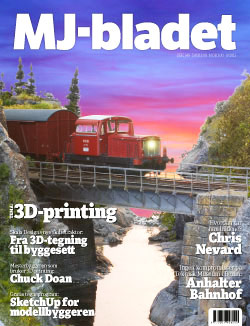
This post is all about me; it's not often that one gets ones name on the cover of a magazine so I feel quite justified in shouting about it.

MJ-bladet is a rather nicely produced Norwegian model railway magazine which showcases the very best in Scandinavian railway modelling, and unlike the UK model railway press has an eager audience for model railways from outside their own country.

In the UK for some some reason whenever a British model railway mag features anything across the pond, the editorial teams get hunted down and viciously threatened by middle aged soap-dodgers who still live 'with mother' and refuse to believe that railways exist anywhere else in the world. This is a tad odd, because railway exhibitions frequently have guest layouts from the other side of the channel that draw an appreciative audience. Sadly though, these same people don't want to see continental modelling in print, however good gracing the pages of the mainstream UK modelling press.

Anyway, this post is unashamedly all about ME, so whether you like it or not I'm going to tell you all about why my name is on the cover! Back in the spring, Practical Photography magazine asked me to write a short article on photographing toy chuff chuffs as well as showing off some of my more recent better pieces of photography.

Unlike in the UK, where we only have the command of 'Office English', 'US English' and to a lesser degree now those early evening soaps have all but vanished 'Oz English'; in Norway there is a market for magazines not only in the mother tongue, but also the English language Practical Photography being sold in many Norwegian newsagents for those that are proficient in 'MTV English'. Despite this worthy UK export, toy chuffs chuffs in a photography magazine is likely to miss its key readership in Norway (and in the UK for that matter), so the top chaps of the MJ-bladet editorial team sought permission to reproduce the article. And what a cracking job they've done, the reproduction is spot on and the design very simple, stylish and only using big bold imagery. They have also used a couple of extra shots not seen in the original article which adds another dimension.

OK, that's it, I've blown my own trumpet enough with this BLOG post, so much so that I might not be able to get through the door later due my briefly over-inflated ego! I'm sure though it will soon be deflated with a barrage of private hate-anything-that-isn't-British-emails from those dreaded soap-dodgers that are always first in the queue at model railway exhibitions.

25 October 2011

Steady progress and a name at last!

I've had a rather busy week out snapping other people's model railways and taking care of the airwaves for a minority satellite TV sports channel. I have however shoe-horned a little time to carry on with the 'Cornish Project' which now has a name in the form of 'Polbrock' which is one of the places the Bodmin to Wadebridge line passed through. I'm not going to be too specific on the history, that way I'll hopefully avoid being nobbled by all the 'model railway experts' who've never even pinned a length of set track to an old door.

As you can see from the snap, the track is now down and wired up. The scenic basics are now taking shape, the not too obvious curved perimeter will allow for the curved backscene to fit between the edge of the layout and the diorama box the tiny little layout will sit inside when finished.

The backscene has been created, well electronically anyway from various bits of West Country photographic imagery, and is now a 4ft x 1ft 300 dots per inch PDF ready for the local printers to print off onto a suitable material as with Catcottt Burtle. No Peco-Disneyesque 3 inch high backscene here, time really has moved on with the advent of the home computer, high street repro houses and commercial printers that will print anything on to anything for a few sovs.

Since the above snap was taken the siding has been ballasted and the scenic sub base built up with tissue paper dipped in PVA coated in coloured plaster.

Jobs still to do...
  • Ballast the through line 
  • Complete the fiddle/staging yards 
  • Finish the presentation diorama box with backscene and built in lighting 
  • Ground colour 
  • Scratch-build 2 buildings for the scenic break behind the camera (pub/old barn) 
  • Scenics

17 October 2011

Count Down to Wycrail!

nevard_111016_catcott_IMG_1527_WEB by nevardmedia
nevard_111016_catcott_IMG_1527_WEB, a photo by nevardmedia on Flickr.

The excellent Wycrail in High Wycombe is in just under 3 weeks on Saturday 5 November, and this year I've been invited to take Catcott Burtle along for the day.

Metal chewing cats helping to wire up a layout, maybe they
 should have been  callled Jaws and Fang?

'CB' is all ready to go, so there's no midnight oil to burn, which will make a nice break fom the norm, but I do need to finish repairing an ex-LSWR lattice signal post that one of the cats chewed the top off. I don't know why, white metal and brass hardly makes a tasty snack even for cats I wouldn't have thought, but I'm no cat so what do I know? Still, I've managed to get the signal into the right shape again and it now works, it just needs the replacement finial fitting in place, ably supplied by the excellent Wizard Models at the recent Scaleforum.

'What's with the class 121 bubble car?' you might ask, well I imagine most are fed up seeing the usual steam trains in photos of the layout, so I dug out this conversion of a Lima 2 car unit I performed back in the early 1980's when the real thing was still running (actually it still is on the Colne Valley Railway). W55033 portrayed, was a regular on the Bridport branch in the line's latter years and was probably my reason for choosing that number seeing we lived in the area for a short time in the 1970's.

Click for more about Wycrail
It actually looks the part, but of course the Highbridge - Evercreech line shut in March 1966, but imagine if the line had remained open to Glastonbury to serve the Clarks shoe factory and to transport revellers to Glastonbury Festival in June?  

16 October 2011

Model Railway Photography


60026 arrives at Cement Quay Old Wharf with a
and empty short rake of MFA high sided box
wagons. The loco will uncouple and run around
the train before propelling it under the screen for
loading. There is no computer Photoshop jiggery
pokery here, the sky is part of the layout painted
onto a nice hight curved backdrop, something that
 is worth considering if you intend to photograph
 your layout alot.
I'm always being questioned about photographing model railways, so here is a 'reprint' from an article I penned for Model Rail July 2008 issue. Cameras have moved on a little since then in that most are capable from producing a good quality A3 print, but the basic rules are the same - 'light it well, keep it still'.

After spending very many hours and money on creating your favourite railway item in miniature, it’s quite likely you’re going to want to record the outcome to share with the friends, on social media, your own website, or of course the model railway press!

The last decade has seen photography change enormously, with mega-pixels & digits replacing film emulsion in this increasingly digital world we live in. This for the casual snapper this has been nothing but a good thing, for now with even the most inexpensive digital camera, what was quite specialist photography is within the grasp of almost anybody.

OK, well, it’s not quite as simple as that, if it was I wouldn’t have written this guide! However, with a few simple rules and easy to grasp techniques, extraordinary good results can be had from the recent breed of high resolution small digital pocket cameras.

Let’s look at some of the key features that spoil good picture:


• Fuzzy?
• Noisy snowy pictures?
• Camera shake?
• Out of focus?
• Badly lit?
• Off colour?
• Too light or too dark?
• Subject too far away?

An out of the box Bachmann 3MT. This has been shot under the
layout's own built in flu lighting which gives nice even illumination.
Despite many manufacturers claiming that, ‘their’ camera will turn you into a brilliant photographer with little effort, some basic techniques and a little understanding of photography will help to give some credibility to their claims though ultimately framing and composition is very much down to the user.

Super fine, fine, ordinary?

Before we take any pictures, we need to be sure that what we record has the potential to be the best quality possible. Always use the finest and biggest – it really does matter! If you’re taking pictures for the printed page, always shoot at the best quality jpeg. The computer screen is quite forgiving, the printed page isn’t. If you’ve leant the camera to the kids or Aunty Mabel, the ‘ordinary’ quality will be fine, after all there’s no point in filling up precious memory with stuff you’ll probably delete anyway (with apologies to any Mabels out there that are top photographers). For serious photography, only ‘Superfine’ (this term may vary depending on camera make) will do. You’ll know when you’ve found it, because it will be the setting that gives you the least number of pictures on your card. Good things come at a price!

Size does matter!

Keep the camera still, the slightest movement
during exposure will spoil the shot
Indeed it does, well in digital photography anyway. Along with ‘superfine’ jpeg just discussed, you need to have the largest picture dimension selected, again as before, the printed page is far less forgiving than the computer screen. Most people have found this out when they try to print a picture from the internet, it looks great on the screen but terrible printed. The terms here are pretty straight forward. ‘L’ meaning ‘large’, ‘M’ for medium & ‘S’ for small. Forget the last two, large is the only option despite what the local pub know-all or salesman down the camera shop might tell you. Again, it’s as before, you know when you’ve found it because it will give you the least number of frames on your memory card!

Noisy snowy pictures?

With the flash turned off when in dark places, you might well find that you get snowy noisy looking pictures? This is because your camera has automatically boosted its sensitivity. Whilst this may be fine for that boozy snapshot down the pub, you probably won’t want to see this effect in your pictures. Check your camera instruction and you should be able to adjust the camera’s ISO, this being the international standard used to rate digital cameras and film’s sensitivity to light. Simply speaking, the lower the number (ISO) the less noisy or grainy the picture will appear. For this reason we need to ideally select the lowest ISO.

Camera shake?

A small bean bag is a great tool. It stops the
camera from damaging the layout and keeps the camera
nice and still

However steady handed you think you are, because we’re photographing something often close up, any movement will be amplified, making the slightest bit of camera shake looking like you took the picture during a 10 plus Richter scale earthquake! A tripod will always be a useful tool, however, if your interest in photography is only passing, understandably it’s unlikely you’ll want to invest in such. There are other options, you could try resting the camera on a cushion or table. A small bag of rice or purpose made bean bag can be very useful (get somebody nifty with a sewing machine or buy a purpose made one), it allowing you to adjust the angle of the camera with little effort.

A nifty trick is to find the camera’s ‘self timer’, that’s the setting you use when you want to do that self portrait whilst on holiday. OK, the idea isn’t that you do a self portrait of you and your favourite piece (well, you can if you like!), use the tool to fire off the camera without touching it – thus reducing the chance of camera shake when the shutter opens. Obviously the camera needs to be supported so that bean bag or bag of rice already mentioned will be ideal!

Out of focus?

Must modern digital cameras will focus very close indeed with their built in auto focus. For real close-ups, you’ll probably need to select ‘macro’ mode, this is often via a button with a ‘tulip’ icon depending on brand of camera. If unsure, check the camera instructions.

Some cameras will allow you to turn the auto focus off. If you have this option, which will again depend on make and model, this will have the advantage of letting you focus exactly where you want to. Another option is to point the camera at the part of the item you want in sharp focus, half press the shutter release (which will set the focus), then with your finger still half pressing the shutter release recompose the shot to the angle you want then fully depress the shutter release. If you’re using the self timer, you can fully press the shutter release button before recomposing, the 10 second delay giving you lots of time.

Mendip is captured mid-take at Catcott during the
making of 'The Return of the Titfield Thunderbolt'
during the late summer of 1956. Of course that's
complete tosh, but I can tell you that the is no computer
addition other than the splirt of smoke from the engine,
 which was added using the 'clouds' filter in Photoshop.
 How do I get more of the picture in focus?

This will again depend on your camera make and model. With many makes, you can set the camera into ‘aperture priority’ mode, this is often displayed as ‘AV’. With this setting you can select a small aperture.

What’s all this small aperture thing? The aperture is an iris much like in ones eye, hold a finger up to your eye and really squint, you’ll notice that you might even be able to see your eyelashes, finger and background all more or less in focus. Choosing a small aperture does the same thing, meaning far more of the picture will be in focus – just what we want! This is known as ‘depth or field’, aperture is normally marked up as numbers, the higher the number, the greater the ‘depth of field’.

Some of the simpler cameras will not let you have any control over aperture or shutter, user changes being via ‘scene modes’ where you select the type of picture you want to take. There are usually modes for ‘sport’, ‘portraits’, ‘landscapes’ fireworks, but sadly no mode for model railway close ups! For this reason you may have a problem getting the camera to select a small aperture for the close ups. However, if you can take your model out side into brighter light, it’s quite likely that the camera’s computer will select a smaller aperture.

If you have yet to buy a small digital camera, and you intend to do quite a bit of model railway photography, it would be a good idea to choose a camera that allows you to have control over the aperture setting.

Badly lit?

You must turn that flash off, direct camera flash doesn’t have a place in our world. Whilst it might be fine for family snaps, it will generally not do our model making any favours, creating flat and quite often washed out pictures with no depth. This can usually be controlled by a button with a ‘lightning’ icon somewhere on the camera.

Getting your subject properly lit, the simplest way, is to take your model outside where the light is good. Overcast and sunshine work well in this respect, both giving different but equally good results.
Another option, especially if photographing a model railway, or using one as a backdrop for an engine or train, is to use the layout’s own lighting. Digital cameras generally have quite good automatic white balance control, which like the eye, should adapt to the lighting on the layout - more on white balance in a moment.

Too light or too dark?

It’s possible that the camera metering is being effected by something very bright or dark within the picture. Photographing a dark engine against a white background or visa versa will do this. Check your camera instructions to see if you can use manual exposure ‘M’ or exposure compensation (often marked as a +/- button).

Off colour?
The resulting photo from the set up below. The computer
smoke is optional of course.

The trick when doing this is to experiment a little, after all, cameras and lighting will vary. Sometimes the automatic white balance will refuse to work as well as you like, when this happens, you might want to experiment with some of the white balance ‘pre sets’, again look at your camera manual. White balance settings are often embedded in one of the menus, and will usually be indicated up with simple icons to reflect the type of light you are trying to balance for. Fluorescent lighting and the new ‘energy saver’ bulbs are the ones most likely to cause issue, due to there being so many different types. Some cameras will also allow you to balance for your specific light using a sheet of white paper in the scene prior to taking pictures.

One thing you cannot do, however clever your camera, is to mix different types of light. Daylight does not mix with tungsten, it being very blue and the latter very orange. The same problem occurs when trying to mix fluorescent lighting which can be very green. Keeping to just one type of light gets around this, the camera can only correct for one type at a time.

What makes a good picture?

Try photographing your trains against a simple back ground.
A large print was used here with the light coming in from the
garden. Note the tin foil to reflect a little light into 
the shadows.
If you’re photographing an item of rolling stock or engine which isn’t on a layout, try to place it in front of a background which isn’t too busy or distracting. Its simplest form can be placing the subject on a length of clean new track in front of a large sheet of curved paper.

Fill the frame, there’s no point in having a picture which needs to be enlarged at a later stage. Rather than zooming into your subject from far way, keep the zoom wide and fill the frame, you will get a more natural perspective.

Make sure your subject is totally dust free – I’m mean totally! The smallest amount of dust or fluff will really spoil a model.
Digital is a great tool, you can analyse the photographic progress as you go along, adjusting brightness, colour and focus then deleting sub standard images and correcting errors as many times as necessary. These cameras can also be very useful for checking progress of model making, sometimes errors and blemishes only show up when you see them on the back of the camera or computer screen. Because the camera is totally unforgiving, it can help us become more critical and better model maker - hopefully!

Useful camera purchase tips
• Buy a camera that has proper ‘aperture priority’, ‘scene modes’ are unlikely to offer enough flexibility.
• 5 mega pixels should be your minimum resolution.
• Mobile phone cameras are no substitute for a proper camera.
• Get a decent sized memory card, the one often supplied is too small when shooting at the highest resolution and picture size.
• Check out camera reviews online prior to purchasing. www.dpreview.com is a favourite, for not only can you download full size image files, you can also compare specs and performance between models.

Sharp tips for sharpshooters
• Fill the frame!
• Keep the camera totally still, rest it on something, tripod, bean bag? Use the ‘self timer’ for hands free operation.
• Select ‘macro’ for close up work.
• Turn that flash off! Light your subject properly, daylight is free and ideal! Experiment with your layout’s own lighting too.
• Check your white balance, ‘auto’ may not always be best – experiment with other settings.
• Use the lowest ISO to minimise noise.
• Always use ‘superfine’ and ‘large’ – size really does matter!
• Get rid of that dust and thumb print on the lens!
• Make sure your subject is clean dust free!

11 October 2011

The Return of the Titfield Thunderbolt

nevard_111011_CatcottB_IMG_1462_WEB by nevardmedia
nevard_111011_CatcottB_IMG_1462_WEB, a photo by nevardmedia on Flickr.

It's not generally known, but following on the success of the Ealing Comedy, 'The Titfield Thunderbolt', the iconic Ealing Studios shot a sequel called 'The Return of the Titfield Thunderbolt' in the summer of 1956. The film was released the following summer, but was a complete flop due to the total Americanization of the cast, so sadly the movie has been lost in the mists of time but does occasionally make a secret appearance as a projected 16mm colour print at Lodge meetings in the area.


The film which was shot on the Highbridge Branch of the former S&DJR and used a Sentinel vertical boilered engine borrowed from the Marriott, Foster & Dent Brewery in Bath. The ex GWR 4 wheeled passenger carriage was loaned from British Railways Pontypridd Permanent Way Department and was hastily repainted in BR Carmine for the film. Sadly the carriage caught fire during a take when the on-board still producing 'Mallingford Magical Moonshine' blew up near West Pennard a couple of weeks after this shot was taken.


Ivan Locksmith, as always was around to capture unusual workings on the former S&DJR, and as usual he has posed his latest car in shot, much like his good friend Ivo peters.


If you believe any of the above, you'll believe anything! Catcott Burtle will be at Wycrail on Saturday the 5th of November, so though it best to dig the old girl out for an up and under. And for people that think photography is all Photoshop these days, only the puff of exhaust blowing in the strong south-westerly is.


Here is a bigger version of the above photo http://www.flickr.com/photos/nevardmedia/6235222235/sizes/o/in/set-72157612020895249/

There is an alternative


I was just looking through last year's Warley Show photos and spotted a couple of shots that didn't make it into print due to lack of space. The subject to today's random post being that we don't always need to use that popular track system produced in a well known holiday resort - there are other options for those who'd like a break from the norm.

Getting to the point; above and below is just one of those from Tillig - the lack of moulded plastic bits to represent those bits on a real point that are made out of rail is one of the first things to catch my eye. The base is also slightly flexible which allows the point to be bent slightly to fit in with a flowing track layout - this until now has only been possible with hand laid track.


Then there is the tiebar - it's nice and slender and not too far removed from the real thing in looks - no crushed Dalek as seen on many ready-to-lay track systems to spoil the look sitting on top. The movement of switch rails simply rely on the rail flexing, no unsightly knuckle joints to fail electrically once painted. I suppose this is starting to read a little like an advert, but I'm not being paid - this just an observation of other options that don't take one down the hand-built route if that's not ones kind of beer.

 Purists will of course say that the track is H0 and that the sleepers are too close together for OO, and that it conforms to European rather than British practice; but people who know me know that my view of toy chuffs chuffs is that it is the overall effect that counts, and above all if things are well done, a far more satisfying model railway will result over that one that maybe has the 'correct' 1963 vintage flangeway bolts surrounded by shoddy modelling.

From an historic scenario, flat bottomed rail to depict a British railway scene with highly distinctive bullhead rail and chairs is maybe too far removed in looks, but from just after the WW2, Britain's railways started to use flat-bottomed rail for the main running lines, so it is quite suitable for that popular transition era onwards which still interests the bulk of Britain's railway modellers.  And of course there is nothing stopping one from using a length of C+L bullhead flexi track in the sidings where the sleepers are often hidden under a layer of clinker, thus hiding the sleeper size and spacing differences.