Friday, 16 May 2008

Radstock's Finest!

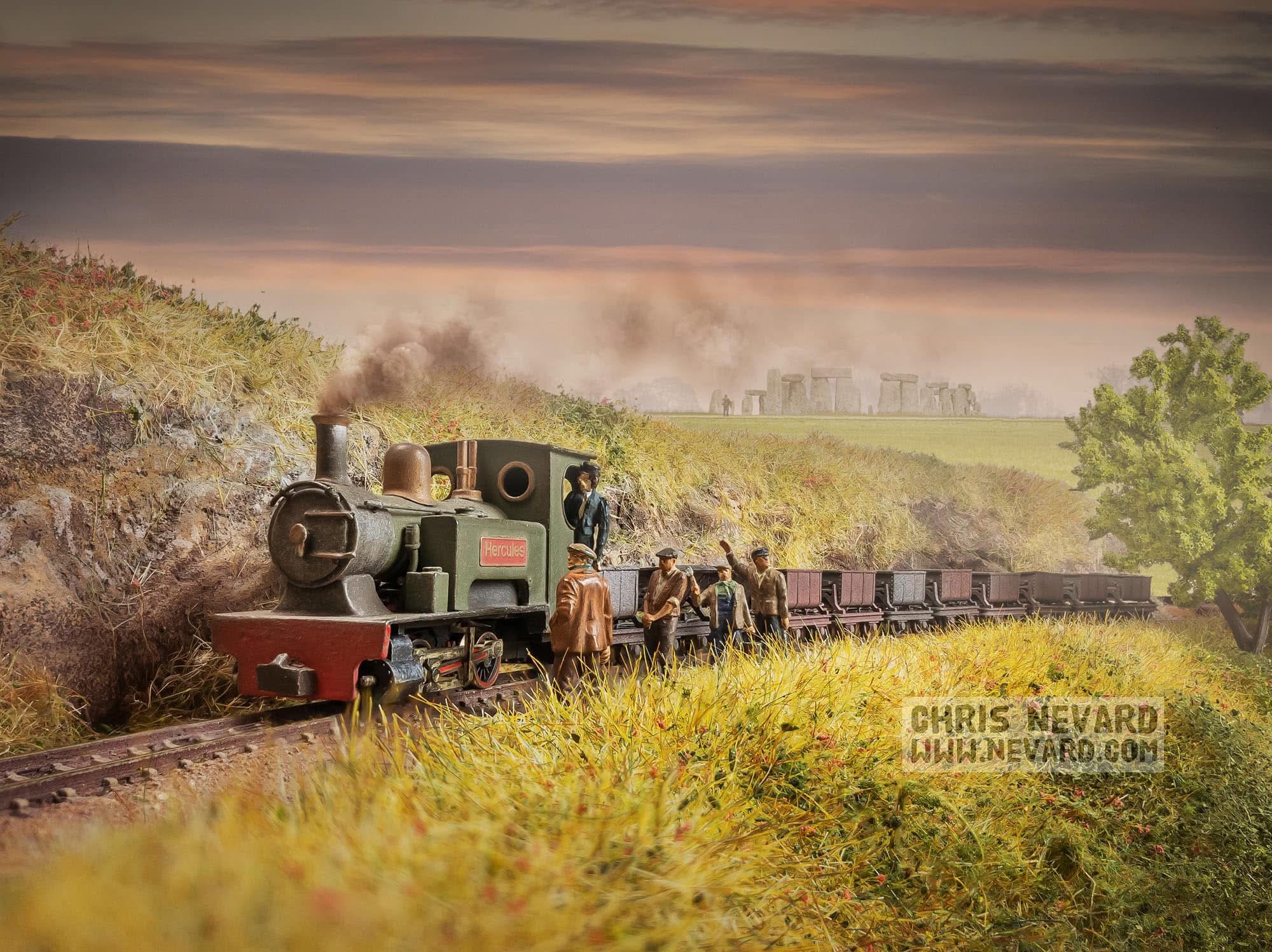
Another 24 hours, another snap, this time showing the beginnings of the grassy bits on the left hand side of the layout. There will be a bank of willow in front of the image with the telegraph pole in the distance to mask the Highbridge side of the layout's exit. The goods shed roof is still loose (and it shows too), pending that there will be some internal detail before being fixed into place. I could say that the reason for the shed's slight lilt to the right is because it's sinking into the bog, it's simply that it has not been bedded into the ground properly yet (I fix all my buildings to layouts - less things to pack up after a show and hopefully no gaps around the bases)...................

The loco is a weathered Bachmann one, renumbered to reflect one of Radstock's finest or worst, depend on your viewpoint. On the former S&DJR, these engines were mainly used as bankers, the 3 link rather than screw coupling being correct for this particular engine. They did make the odd sojourn down the Highbridge Branch from time to time.

The photographer's spanking new Austin A30 Countryman (Springside) contrasts well with wheezy LMS heap which is performing a spot of shunting (Parkside Dundas LMS CCT). The area just to the right of the car is likely to be a small coal dump.

Tuesday, 13 May 2008

Deepest, remotest, most rural Somerset....

The pic to the left of Catcott Crossing Halt, shows the attack of the hanging basket liner earlier today. It will be trimmed, using small scissors and a vacuum cleaner to make it stand up. It will then be sprayed (a brush will be used upder the platform) very lightly with a highly diluted PVA/yellowy/browny/greeny emulsion mix using a toothbrush. Then, with an old vacuum cleaner it will be vacuumed again whilst wet to make sure the grass is still as upright as possible. The grass under the flatform will be left messy, the grass at the rear will be trimmed more so it looks less like the mower has been emptied. The glue/paint mix ultimately sets hard and stops the shreds of hanging basket liner breaking off and going everywhere it shouldn't.

The courser ballast is sand from the Solent strained through a fine sieve, something I've been using for years (Combwich). I did a test section the other night with some Green Scenes stuff but it didn't look right, it looking like old tea leaves in colour once dry. The beach sand is tiny pebbles, being almost round, the grains literally roll into place. It also takes PVA well too, in fact alot better than granite or whatever it is that the scenery suppliers give us.

‘Anglicizing an Austrian’

'Anglicizing an Austrian’
aka ‘transforming a smart Austrian, into a rusty, old & possibly English style leaking wheezer geezer’.

Having thoroughly enjoyed the feature by in a recent 009 Socielty Newsletter on how to anglicise the Bachmann Liliput HO Zillertal Bahn 2-6-2 a couple of months ago in 009 News, I remembered that I had one of these locomotives hidden in the garage collecting dust.

It was from one of those spur of the moment purchases a couple of years before, probably because I feared it was going out of production.

Anyway, back to the conversion, I followed the instructions as in 009 News closely as possible as my spare parts box allowed, using plasticard to deepen the body and to revise the cab windows to something more British is style.

I then had to improvise, not having a suitable smokebox door, I removed the flat head from a drawing pin, this becoming the door! A hole was drilled into the middle to take and old handrail knob from a Kays kit (there must be hundreds of these dreadful kits never finished?) and a pin head to act the lever for opening it.

Further handrail knobs and bits of brass wire were used for the cabside handrails. British locos have less in the way of steam spaghetti than their foreign counterparts, so some of those bits were removed (I’m non technical, I know steam locos use coal, fire and water, that’s about it!). Some thin beading was added along the edges of the side tank tops from fine plastic strip. Then, some coal rails were added at the cab end of the tanks, after seeing a picture of the Former Welsh Highland Railway loco ‘Russell’ in a book of ‘The Railways of Purbeck’ by the late R.W. Kidner. The little loco then had a couple of ‘buffer beams’ added out of some spare girder section from a Walther’s Cornerstone building kit for that real DIY bodged repair often seen on industrial loco’s. I’ve always liked industrial grot over twee pretty engines, I think it would be true to say that it has been achieved here!

That’s just about it, the loco was then sprayed matt black from an aerosol, had brass elliptical maker’s plate from a Class 52 Western of all things! It was then weathered up in my usual fashion using matt colour washes and dry brushing, until it started to look suitably decrepit.


Whilst I’m not sure it looks totally British in style, it maybe could pass as something UK built for export to the colonies. My story is that it came back from war torn France after the Great War.

The loco, after a good couple of hours running round and round Arne Wharf (where it really looks the part I hasten to add), runs beautifully. The only problem is that due to the large overhand and my tight curves, most stock, irrespective of which way around the loco is facing, tends to get pulled off the rails on the bends! Oh well, better build another layout!

Saturday, 19 April 2008

When steam goes in the wrong direction

In the good company of RPG members Mr Wright & Mr Brunt, 34067 'Tangmere' successfully hides the Queen of Scotts rake of vintage carriages, as it blasts through Walton on Thames with a private birthday charter from Weybridge to Canterbury on Saturday 19 April 2008.

Thursday, 17 April 2008

Canon G9 appraisal


Canon G9 review. As long as you don't expect this camera to perform like a DSLR, for a small carry everywhere camera it's great. Saying that, with careful technique and with the right subject, shooting RAW at 80iso comes pretty close. Build quality is quite assuring with the cool metal body. The lens is the weak link I imagine, just have to look after it I suppose, after all it is an electronic item not really designed to be thrown about like a football. My fear is that I might turn the camera on whilst it’s in my pocket, Would it break? Or would it simply not extend the lens with some kind of built in protection? I’m not trying it out.

If you want to be serious with it, Adobe RAW in CS3 does a very good job removing the slight chromatic errors towards the edge of the field with high contrast subjects. The output to 400 iso is very manageable if shooting RAW, the Adobe N/R being very effective in controlling excess noise without losing too much detail. OK, it won't compare to a DSLR but a tiny sensor is never going too. The images, especially at the lower ISO settings do have a nice quality about them, with well rounded tones, colour and white balance.

The real bonus for me (I’m old school, I like total control here) is easy to use manual exposure control backed up with the live histogram so one can keep and eye on those all important highlights. If you do blow them in an important area, when shooting RAW the Adobe converter reclaims lost information quite well – better than I thought it would after reading the review on dpreview. Being able to set a custom white balance off a white sheet of paper is very useful too when shooting JPG, which offers less post production adjustment than with RAW.

Downside, well, very few as long as one understands the limits of a small camera like this (not as small as some, but on par with a compact 35mm film camera – remember them?).

The screen, wonderfully large and sharp, my only grip is that it is far too saturated and contrasty, leading one to believe that shadows might be clogged and highlights blown when in fact they aren’t. I’ve learn to rely on the histogram when reviewing images on the screen, after initially not believing it. Not the end of the world now I understand.

If shooting action or one needs high iso performance I’d be using a DSLR, there’s no argument there, it’s silly to think a camera like this is going to be anywhere close to a DSLR in this respect.

If I had the chance to wind the clock back and had the option to decide whether to purchase this camera based on user experience gained, I wouldn't think twice about buying it again!!

Friday, 11 April 2008

Streak!

Captured between rain showers, LNER A4 Class 4-6-2 no 60019 Bittern, powers away from Virginia Water with a private charter Euston-Staines-Guildford-Redhill-Victoria) on Friday 11 April 2008.

Wednesday, 9 April 2008

Silfor grass

This morning's work on Catcott Burtle(about 45 mins), saw the rhyne bed painted a darkish grey emulsion colour, then coated with a thick layer of PVA (first of about 4 or 5 coats). A couple of patches of Silfor were added to gauge effect. The area with the rails etc is still bare cork with the grey/red primer mix, the ground cover and ballasting yet to be done (modelling clay for general surface including siding, fine granite or such on the 'mainline'.).

PVA is just white wood working glue, I guess you can get it world wide. Some brands dry clearer than others. I use the one in the dark green bottle, either Evostick or Unibond (cannot recall, not being anywhere near the bottle at present - well the glue bottle anyway). I've often thought that that varnish is too shiny (odd thing to say I know), it showing up any dust present and being more the colour of best bitter rather than mucky water. I've never seen rich blue water either apart from in the Med, around the UK it's gerally shades of grey with hints of brown, depending on how much mud is in it (the nearby Thames the other week was the colour of tea with all the mud in it after the heavy flooding rain). Any blue, will just be the reflection of a blue sky.

Saturday, 22 March 2008

Cold and wet..............

Having just crossed over from the down slow onto the down fast, Merchant Navy Class Pacific No.35028 'Clan Line' proundly displaying 'John Bellamy 1931-2007' powers away from Weybridge with 'The Southern Sunset' steam charter from Victorian to Salisbury, on a wet and bitterly cold Saturday 22 March 2008.

Monday, 17 March 2008

Shark Attack!

Posed on Cement Quay, a modified Hornby 'Shark' departmental brakevan, a recent release from the Margate company. Modifications include, door opened up (knife and glue job), weathering and the addition of a couple of Preiser orange clad railway workers.

Saturday, 8 March 2008

Rural Industrial Grot


A recent shot of the new dried peat transfer shed on Catcott, my 5'00 x 15" '00' diorama/layout of Catcott Crossing which in my parallel universe turned into a halt with siding to serve the local peat works.

Sunday, 2 March 2008

The End of Printed Matter?

Spurred on by a current thread on RM Web, I felt an over due ramble........

Like many, in my world, increasingly far too much time is spent in front of a screen, be it a computer, mobile device or television.

Despite this, people are frequently discussing whether the printed page will be around for much longer. For me, there's nothing like having a good read during the daily ablutions or sitting on a train from a device that doesn't need batteries - I don’t think I’m that unusual in this respect? Having a coffee with my wife whilst casually browsing through a paper magazine or newspaper, is somewhat more sociable than reading a virtual version of the same thing on a laptop.

We're all different and have differing needs I suppose, and because of this there is an increasing requirement for electronic versions of their favourite printed media for those anti social desk tied animals. So, back to the question, does this mean that printed media will die out? No, my feeling is that there'll always be a place for the printed page for a long time yet for reasons already mentioned.

To put this a different way, in the 1960’s, it was thought that we would be living under round or in ‘space age’ high rise flats, wearing space suits (the ‘shell-suit’ never did really catch on), popping food pills. Of course what happened is that people like to touch the past, they love their Victorian villas, they like organic food and nice traditional wooden furniture, olde worlde pubs, steam trains and country walks. What happened to the high rises? They’re pulling them all down and frequently replacing them with lower more traditional looking structures – well they are where we live!

However, things do change, and in the long term of course publishers will have to embrace different and newer formats to run in parallel if they're to remain in business - like it or not. Whether an electronic clone of their current publication is the only route to take is another matter, with people increasing turning to the internet for breaking news, publishers may have to consider a more topical newsy downloadable or web version of their magazines. This would leave the printed magazine for less immediate stuff like 'layout features' and 'how to do' articles etc. The biggest problem ahead will be getting people to part with cash for similar material that may be free on another web page, this I fear will be tricky, albeit impossible. Sponsorship and advertising may be the answer along with a subsidy from the printed version.

Something that could happen right now would be for publishers make back issues available electronically as a PDF (or suchlike) for download or CD for a slightly lower rate than a paper reprint. Like many no doubt, recently I had to recycle dozens of magazines simply due to lack of storage - which is such a shame.

Wednesday, 27 February 2008

Sunny morning at Midsomer

Tuesday the 26th February, we had a chance to pop by Midsomer Norton. The Somerset & Dorset Railway Heritage Trust have been very busy putting on the finishing touches to the recreation of the famous signalbox.
Since our last visit, the running in board on the up platform has appeared too, this looking very smart on the Southern Region Green it would have worn in the 1950's.


Winding the clock back to around 1972, 6 years after the line closed, for what was thought for good. The B&W image here shows the original signal box shortly prior to demolition. Who'd have thought just over a generation later that S&D fan would be able to enjoy 'Midsomer Norton South' signal box again in all its glory, albeit a replica. Hopefully soon a Fowler 2-8-0 S&D 7F will soon be able stand next to this fine recreation of one of England's favourite signal boxes.

The rest of the images from Tuesday 26 Feb 2008:
http://sdjr.fotopic.net/c1465954_1.html

Pictures from the past 35 or so years:
http://sdjr.fotopic.net/c1118990.html